Private 4G/5G core software with on-prem AI

Operate private 5G with on-prem AI, without exporting network data.

NextEPC combines an open 4G/5G core, accelerated local breakout, and on-prem AI for network operations and edge services. You keep control of the core, the data path, and where AI runs.

On-premises Air-gap capable Open-source foundation Policy-controlled egress
3GPP compliant
LTE, 5G, and NB-IoT core network software
4G and 5G SA
LTE EPC, CBRS, and standalone 5G core
AccUPF on DPDK
High-throughput local breakout
On-prem by design
Core, policy, and AI under your control

Why NextEPC

You keep control of the core, the data path, and the AI.

Private connectivity is only one part of the picture. NextEPC keeps subscriber data, network policy, user-plane steering, and AI inference inside infrastructure you operate.

Open-core control

Operate the core software, subscriber data, and network policy under your own administrative control.

On-prem and air-gap deployment

Run connectivity, operations tooling, and local inference inside a controlled or disconnected environment.

Cellular and edge in one platform

Combine 4G/5G control, accelerated local breakout, and edge services without assembling unrelated platforms.

Open-source base, commercial delivery

Build on the open-source NextEPC code base with enterprise features, deployment support, and product accountability.

Products

Three products on one core platform.

Start with the 4G/5G core, then add AI-assisted operations or policy-driven edge control as the site requires. Each product has a separate responsibility and can be adopted independently.

Product 01Available

NextEPC 5G Core

A self-operated 4G/5G core for private, community, and edge networks. Deploy on commodity infrastructure and retain control of every core function.

Core capabilities

  • 5G Core Enterprise EditionStandalone 5G core with advanced features, slicing, and commercial support.
  • LTE EPCProven 4G core for private, community, and CBRS cellular networks.
  • AccUPFAccelerated UPF on DPDK for high-throughput local breakout.
Product 02Available on request

NextEPC AI Ops

An on-prem operations assistant grounded in your own core logs, metrics, configuration, and approved technical documentation.

Operations workflow

  • Procedure-aware diagnosisCorrelates registration, session, policy, and user-plane events.
  • Grounded recommendationsShows supporting evidence, source references, and confidence indicators.
  • Operator-approved automationValidates proposed changes before controlled rollout and rollback.
Product 03Available on request

NextEPC Edge Gateway

A policy-driven edge control layer that steers traffic to on-prem services while preserving encryption and minimizing external data movement.

Edge capabilities

  • Metadata-driven policyUses slice, DNN/APN, UE group, and provisioned application identity.
  • Local AI routingDirects selected traffic to on-site inference through the user plane.
  • Controlled egressAllows only policy-approved outputs or metadata to leave the site.

Product 01 Available

NextEPC 5G Core

A self-operated 4G/5G core for private, community, and edge networks. Run the control plane, subscriber database, policy, and user plane on infrastructure you administer.

5G

5G Core Enterprise Edition

3GPP standalone (SA) core with advanced features that scale to commercial deployments, plus support, consulting, and deployment services.

5G SA, slicing, enterprise support
4G

LTE EPC

MME, SGW, PGW, HSS, and PCRF for private LTE, community cellular, and CBRS deployments.

LTE EPC, CBRS-ready
UPF

AccUPF

Accelerated UPF on DPDK for high-throughput local breakout and low-latency edge traffic.

DPDK, local breakout, v1.6

Core responsibility

Connectivity, identity, sessions, policy enforcement, and forwarding.

  • Customer-operated deploymentRun on commodity servers, virtual machines, or dedicated edge infrastructure.
  • Local user planeKeep site traffic local through UPF breakout and QoS policy.
  • 3GPP-compliant and extendedLatest 3GPP specifications plus S1/X2 aggregation, proxying, and local breakout.
Open source

Start with the open-source core and move to the Enterprise Edition for production

Build and test a full LTE/5G core with the open-source NextEPC and Open5GS projects. The Enterprise Edition adds advanced features, deployment services, and commercial support.

Product 02 Available on request

NextEPC AI Ops

An on-prem operations assistant for 4G/5G core networks. AI Ops analyzes management-plane evidence such as logs, metrics, traces, configuration, alarms, NWDAF output, and approved technical documents. It does not sit on the user-traffic path.

Workflow overview (management plane only)

AI Ops observes the core, explains failures, and leaves decisions to the operator.

NEXTEPC AI OPS: ON-PREM OPERATIONS INTELLIGENCE MANAGEMENT PLANE ONLY, NOT IN THE USER-TRAFFIC PATH ON-PREMISES SECURITY PERIMETER OBSERVED NETWORK NextEPC 4G/5G Core Customer-operated network functions and infrastructure CONTROL / POLICY AMF SMF PCF NRF USER PLANE / ANALYTICS UPF (AccUPF) NWDAF, telemetry AI Ops observes operational evidence. Application payload remains outside its scope. USER TRAFFIC PATH IS NOT PROXIED BY AI OPS logs, metrics, traces, alarms EVIDENCE INTAKE Logs Metrics Traces Configuration Approved docs Local evidence store, deployment runbooks, 3GPP procedures, confidence metadata ON-PREM INTELLIGENCE NextEPC AI Ops Correlates 4G/5G procedures across network functions and infrastructure events. Procedure-aware diagnosis, evidence retrieval, configuration and change validation Diagnosis Likely cause, affected NF,and procedure stage Evidence Source references, timeline,and confidence indicators Validation Config, policy, topology,and runbook checks OPERATOR APPROVAL → STAGED ACTION → VERIFICATION / ROLLBACK approved change only INITIAL OPERATIONS WORKFLOWS Registration / auth PDU session Policy / QoS UPF / local breakout Change-plan review

AI Ops is a management-plane product. It analyzes operational evidence and supports diagnosis, validation, and controlled change workflows. It does not inspect application payloads or replace the core user plane.

  • Procedure-aware correlationLinks registration, authentication, PDU-session, policy, and user-plane events instead of treating each log independently.
  • Grounded answersPresents supporting evidence, source references, and confidence indicators rather than unsupported assertions.
  • Configuration validationChecks proposed changes against current topology, policy, deployment constraints, and approved runbooks.
  • Operator-controlled automationRequires operator approval before staged execution, post-change verification, or rollback.
  • Disconnected deploymentCan run with local models, local documentation, and local telemetry in controlled environments.
  • UE registration and authentication failure investigation
  • PDU-session establishment and DNN selection problems
  • Policy, QoS, and slicing configuration review
  • UPF reachability, local-breakout, and forwarding diagnosis
  • Change-plan generation with operator approval and rollback
Responsibility boundary

AI Ops consumes operational evidence and proposes or validates actions. It does not inspect application payloads and does not replace the core user plane.

Product 03 Available on request

NextEPC Edge Gateway

A policy and orchestration layer that converts 5G session and subscriber context into local-breakout and edge-service steering intent. PCF and SMF translate that intent into core policy, and the SMF installs PDR, FAR, and QER rules on the UPF through N4.

Architecture overview (private 4G/5G scope)

Policy is derived from 5G context and enforced by the existing core.

NextEPC Edge Gateway 5G context → policy intent → PCF / SMF orchestration → UPF enforcement CUSTOMER SECURITY PERIMETER (ON-PREM) PRIVATE 4G/5G DEVICES Cameras / robots Sensors / IoT Machines / OT Enterprise UEs 5G-AKA, subscriber and session context NextEPC 5G Core CUSTOMER OPERATED, ENFORCEMENT REMAINS IN THE CORE Policy integration: PCF / SMF S-NSSAI DNN UE GROUP DEVICE APP ID Policy intent is translated into session rules. SMF → N4 User-plane enforcement: UPF PDR, FAR, QER, UL CL, local breakout Application payload is not openedby the policy layer. steered user traffic POLICY & ORCHESTRATION LAYER NextEPC Edge Gateway Produces policy and steering intent from network-known 5G context. Governs authorized local services, optional egress, and the decision audit trail. POLICY INTENT SERVICE TARGET EGRESS RULE AUDIT TRAIL policy / orchestration API AUTHORIZED ON-SITE ENDPOINTS Customer and partner edge applications Edge Visionvideo endpoint Private LLMRAG / inference Industrial appsrobotics / OT The authorized endpoint, not the core, terminates and processes application payload. Optional external service POLICY APPROVED ONLY request, output, metadata Initial scope: private 4G/5G. The Edge Gateway produces intent, PCF/SMF orchestrate, and the SMF installs UPF rules through N4. No inline payload-inspection appliance.

The Edge Gateway is a policy and orchestration layer, not a new inline user-plane box. It uses network-known 5G context to produce intent; PCF and SMF translate that intent, and the SMF installs enforcement rules on the UPF through N4.

  • 5G-context policyUses network-known context such as slice, DNN, UE group, subscriber policy, and provisioned application identity.
  • Core-native enforcement pathSends policy intent to PCF and SMF. The SMF programs the UPF through N4 rather than inserting a new inline forwarding appliance.
  • Local service steeringDirects eligible sessions or flows to authorized on-site endpoints through local breakout.
  • Governed external accessControls which service requests or outputs may cross the site boundary and records the decision trail.
  • Encrypted-payload preservationPolicy is based on provisioned network context. Application payload is opened only by its authorized endpoint.
  • Private 5G local breakout to edge-compute services
  • Per-slice or per-device access to on-prem AI endpoints
  • QoS-aware camera, robot, sensor, and industrial traffic steering
  • Controlled cloud access for explicitly approved services
  • Policy and audit integration for multi-site private networks
Initial scope

The first product scope is private 4G/5G. Converged Wi-Fi and wired policy can be considered as a later extension after the cellular control path is validated.

Products

How the three products work together.

The NextEPC 5G Core manages identity, sessions, QoS, and user-plane forwarding. AI Ops observes the management plane. The Edge Gateway supplies policy and steering intent to PCF and SMF, and the SMF installs PDR, FAR, and QER rules on the UPF through N4.

Deployment overview

All three products run inside the customer security perimeter.

On-premises security perimeter
Management and analytics plane
NextEPC AI Ops
Correlates core logs, metrics, configuration, and NWDAF analytics for fault diagnosis, root-cause analysis, and validated change recommendations. It sits beside the core and is never on the user-traffic path.
Logs, metrics, tracesNWDAF analyticsRoot-cause analysisChange validation
Policy and steering control
NextEPC Edge Gateway
Decides traffic policy from session metadata (slice, DNN/APN, UE group, and provisioned application identity), then sends policy and steering intent to PCF and SMF. The SMF translates that intent into PDR, FAR, and QER rules and installs them on the UPF through N4. The gateway is not an inline payload-inspection appliance.
Metadata-driven policyPolicy APIPCF / SMF integrationUPF rule enforcementEgress governanceAudit trail
User plane and data path
Private devices
Cameras, sensors, machines
5G-AKA, site identities
→
NextEPC 5G Core
Control plane and AccUPF user plane
Enforces the programmed policy, local breakout
AMFSMFPCFUPFNWDAF
→
Edge applications
Customer and partner workloads at the on-site edge
Edge VisionPrivate LLM, RAGIndustrial apps
Controlled egress, governed by the Edge Gateway approved requests or metadata only, to optional cloud services

Each product owns one responsibility. The 5G Core authenticates devices, manages sessions, and forwards user traffic. The Edge Gateway derives policy intent from metadata. PCF and SMF translate that intent into user-plane rules, and the SMF installs those rules on the UPF through N4. Encrypted application data is decrypted only at its authorized endpoint, such as an on-site edge service. AI Ops observes the management plane and proposes changes for operator approval. Raw video, subscriber data, and operational records can remain within the site.

Demo

Automatic fault detection and recovery with a local LLM.

This recording comes from the Phase 1 demo system: one server with one NVIDIA A30 GPU, with every component running on site. A packet-drop fault is injected into the live UPF path. NextEPC AI Ops detects the loss, applies a predefined recovery action, verifies the repair, and the local LLM explains the root cause.

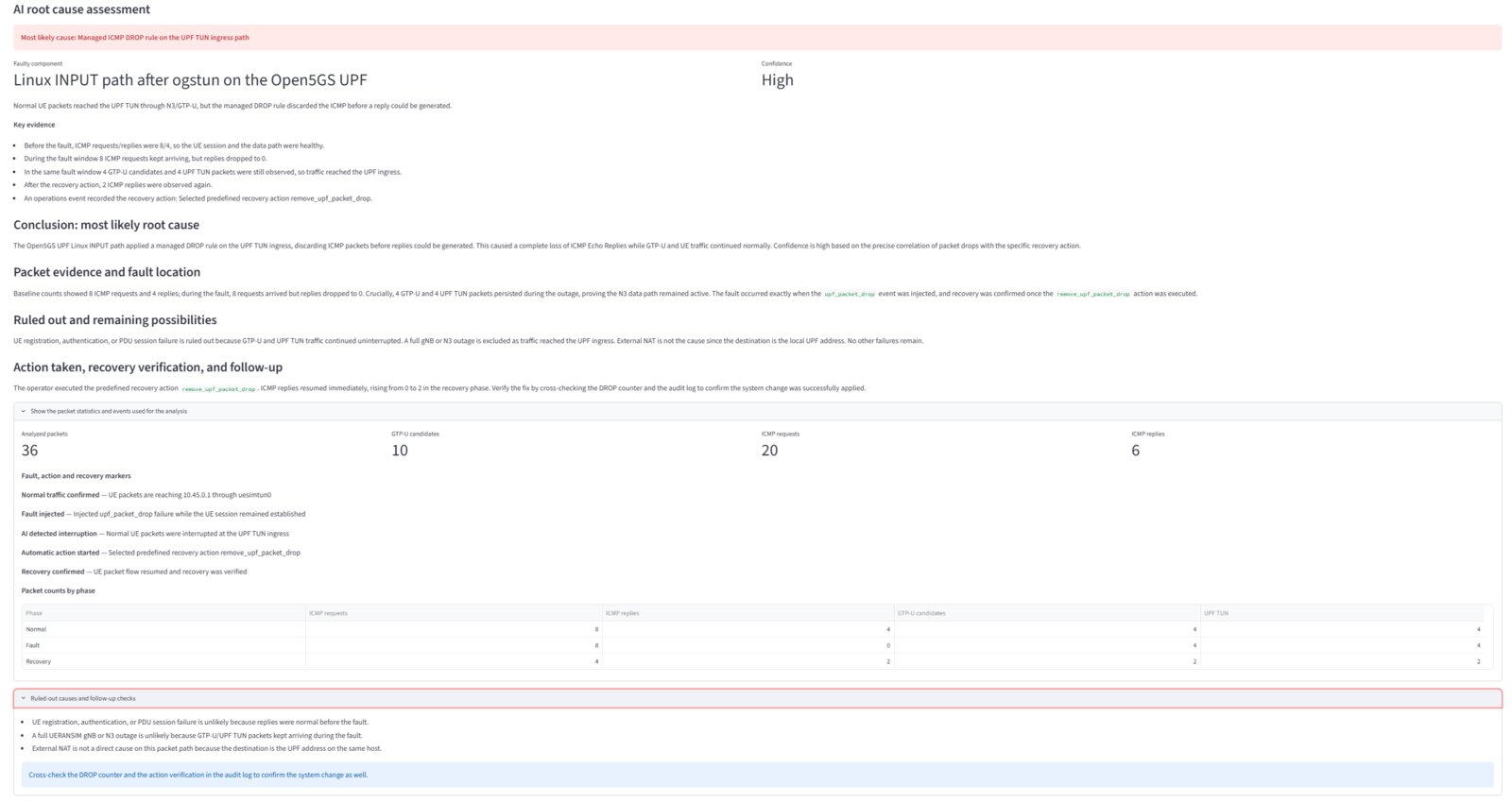
UE echo replies drop from 1 to 0 when a managed DROP rule is injected at the UPF TUN ingress, and return to 1 after the recovery action remove_upf_packet_drop is applied and verified.
Observe, diagnose, decide, execute, verify Live traffic, not a simulation All inference on site with a local LLM on one GPU
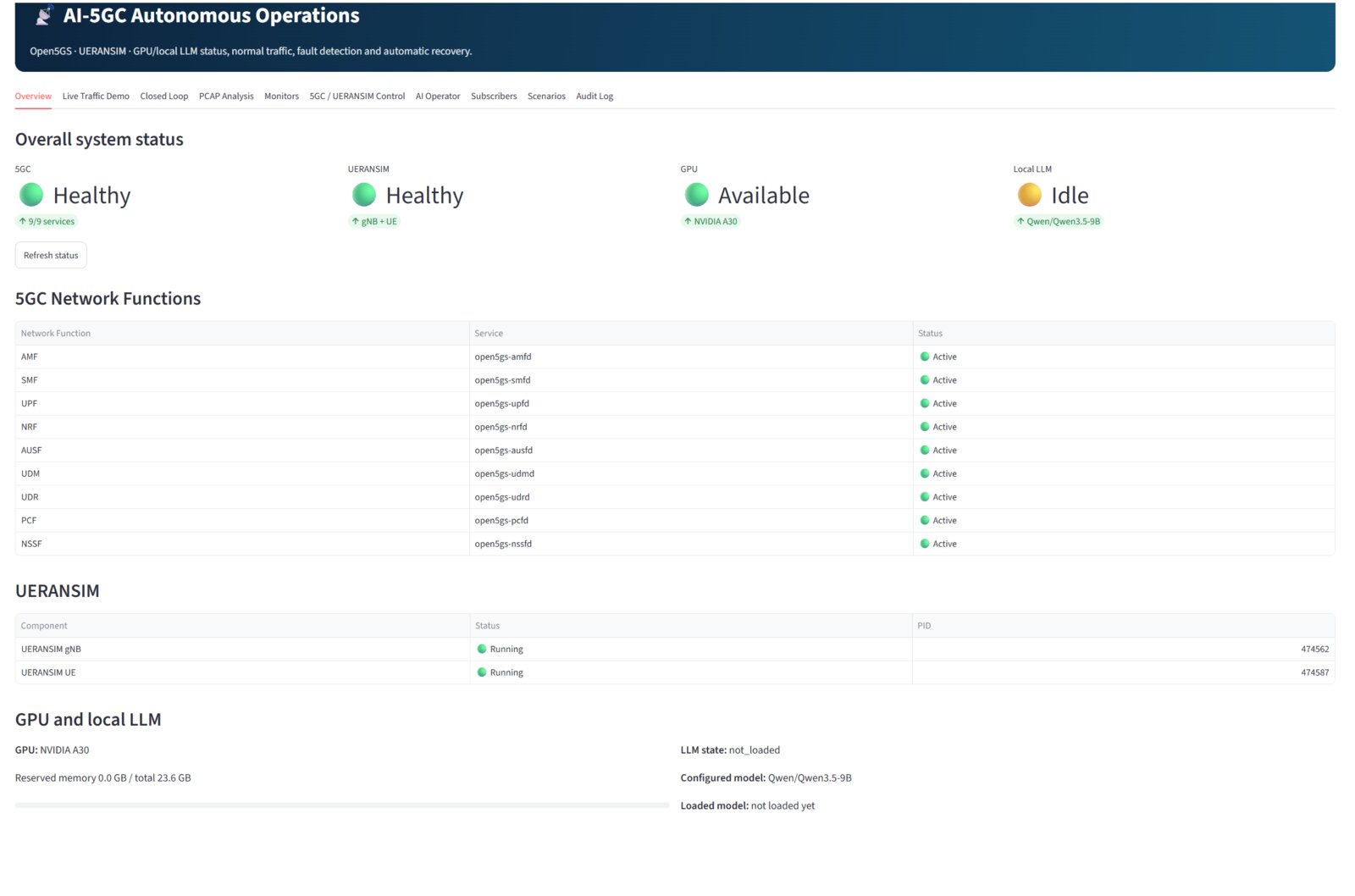
Dashboard overview showing nine active Open5GS network functions, running UERANSIM gNB and UE, and local GPU/LLM status
System overview. The dashboard shows all nine core network functions active, the gNB and UE registered, and the on-site GPU with its local LLM.
AI root-cause assessment identifying a managed ICMP DROP rule on the UPF TUN ingress path with high confidence, including packet evidence by phase and ruled-out causes
Root-cause assessment. The local model reports packet evidence by phase, ruled-out causes, and a high-confidence fault location at the UPF ingress.
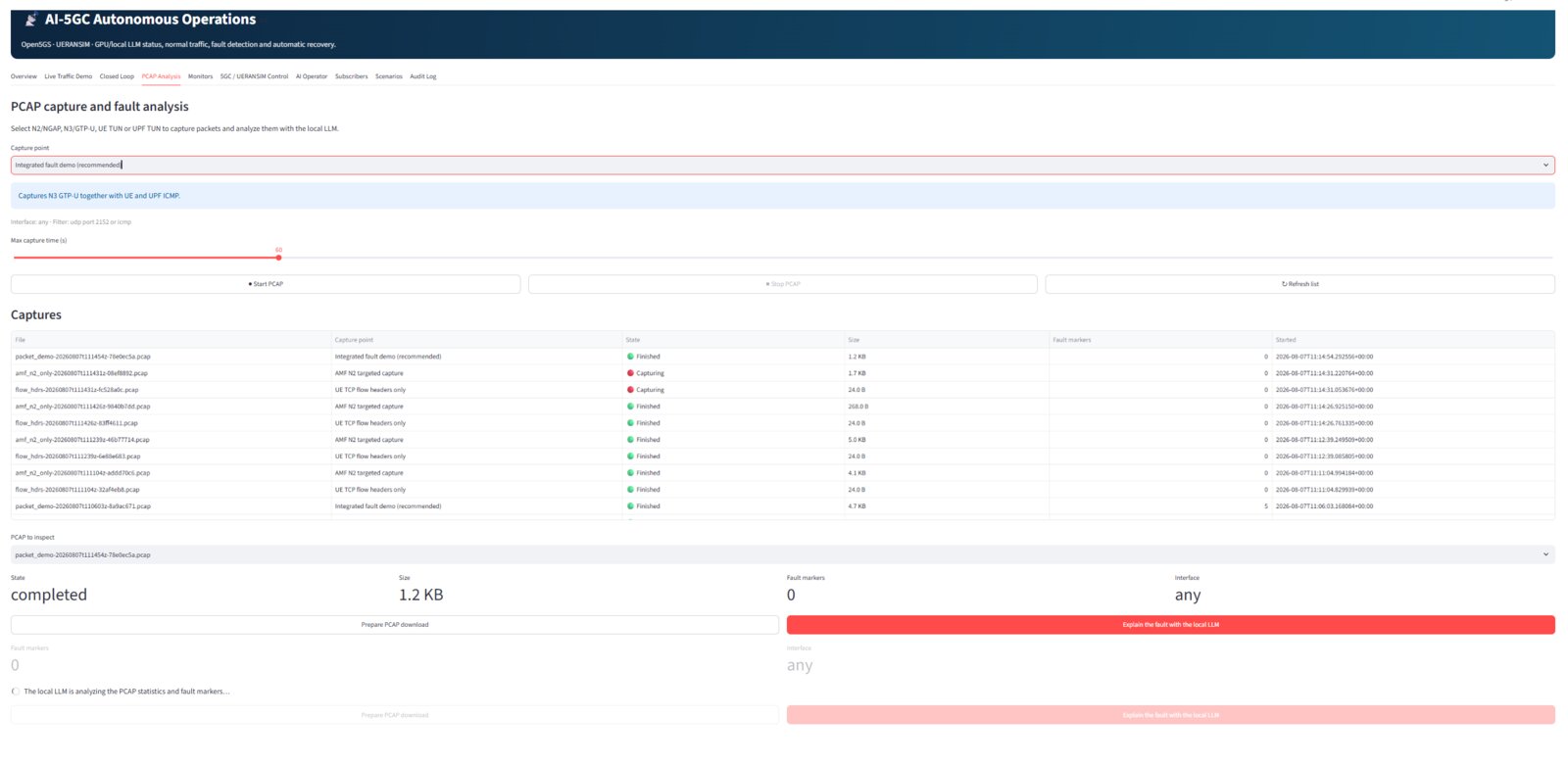
PCAP capture and fault analysis screen with capture points for N2/NGAP, N3/GTP-U and TUN interfaces and a button to explain the fault with the local LLM
PCAP capture and analysis. Captures on the N2, N3, and TUN interfaces, with packet statistics and fault markers passed to the local LLM for a diagnosis.

Recorded from the Phase 1 demo system, not from a simulation. The core runs on open-source Open5GS network functions. Fault injection is deliberate, recovery actions are predefined and selected automatically, and diagnosis and explanations are generated by a locally served open-weights model. No cloud service takes part in detection, recovery, or analysis.

Solutions

Where NextEPC is used.

Private cellular networks for sites that need reliable connectivity, local processing, operational visibility, and a clear data boundary.

Manufacturing and robotics

Connect mobile robots, cameras, sensors, and machines while keeping control and analytics on site.

Healthcare campuses

Support controlled mobility and local applications within hospital and clinical network boundaries.

Defense and public sector

Operate self-contained networks with local identity, policy, telemetry, and inference services.

Utilities and critical infrastructure

Keep operational traffic local while connecting field devices and edge control systems.

Transportation hubs

Provide deterministic local connectivity for cameras, operations systems, and mobile equipment.

System integrators

Package repeatable private 5G and edge-AI deployments across multiple customer sites.

Example solutions

Example solutions built on the platform.

These examples run on top of the 5G Core, AI Ops, or Edge Gateway. They can be supplied by NextEPC, a partner, or the customer, and they are not additional platform products.

Edge application

Secure Edge Vision

On-site person, zone, and intrusion analytics reached through private 5G local breakout. Video is processed at the authorized edge endpoint.

5G Core + Edge Gateway + vision application
AI application

Private LLM and RAG

Local inference over controlled enterprise or operational data with routing and egress governed by site policy.

Edge Gateway + customer or partner AI
Industrial integration

Robotics and OT services

Reliable cellular access, QoS, and local processing for robots, mobile machines, sensors, and operational applications.

5G Core + AccUPF + industrial applications
Operations workflow

Multi-site network operations

Common operational evidence, diagnostic workflows, and controlled change procedures across repeatable private-network deployments.

5G Core + AI Ops + system integrator

Partners

Partners.

A number of industrial partners in the LTE/5G and IoT areas work with NextEPC solutions.

R2C2

R2C2 is the leading innovator of robot automation and collaboration platform to make dangerous and repetitive industries safer and more secure. With its intuitive robotic platform, you can integrate different robots into your robot fleet effortlessly.

Learn more →
Drop Wireless

Drop Wireless is the Network Infrastructure Built By You. Distributed, Community-Driven, and Focused on Transparency.

Learn more →

News & Research

News and research highlights.

Company news, product releases, and research papers built on NextEPC.

News

NextEPC expands into AI-assisted private networking

NextEPC is extending its open-core foundation with on-prem operations intelligence (AI Ops) and policy-driven edge control (Edge Gateway).

Demo

Automatic fault recovery with a local LLM

Phase 1 demo: fault injection, automatic recovery, verification, and a written root-cause explanation, all on one on-site server.

Release

AccUPF v1.6: accelerated UPF on DPDK

A DPDK-based user plane for high-throughput local breakout and low-latency edge traffic, released September 2023.

Research highlight

P4EC: Enabling Terabit Edge Computing in Enterprise 4G LTE

A P4 programmable switch redirects selected traffic to a local edge cloud at terabit throughput, with NextEPC as the LTE core and no change to the core itself. USENIX HotEdge 2020.

Research highlight

ExLL: An Extremely Low-latency Congestion Control for Mobile Cellular Networks

Receiver-side inference of cellular link capacity and minimum RTT keeps queues short and latency low without bandwidth probing. ACM CoNEXT 2018.

Research highlight

CASTLE over the Air: Distributed Scheduling for Cellular Data Transmissions

A client-side adaptive scheduler spreads device transmissions over time to improve spectral efficiency and battery life, demonstrated on NextEPC. ACM MobiSys 2019.

About Us

About NextEPC.

NextEPC Inc. develops software for LTE, 5G, and NB-IoT core network entities so that organizations can build and operate their own private cellular networks. The company has provided open-source LTE EPC software since 2017. The software is fully compliant with the latest 3GPP specifications and extended with functions such as S1/X2 aggregation, proxying, and local breakout.

We provide the 4G/5G core, professional services, and commercial support, and we are extending that foundation with on-prem AI for network operations and policy-driven edge services. The customer keeps control of the core and the data path.

Open Source

Open source and the Enterprise Edition.

Open5GS is the official open-source 5G core project and serves as the trial version of the NextEPC 5G Core. The Enterprise Edition adds advanced features, deployment services, and commercial support.

NextEPC and Open5GS open source

Build and test a full LTE/5G core on commodity hardware. The demo runs its core on Open5GS network functions.

  • LTE EPC (NextEPC)Open-source 4G core. Version 1.0.0 has been available on Ubuntu 18.04 since May 2019.
  • 5G core (Open5GS)Official open-source 5G core project and the trial version of the NextEPC 5G Core.
  • 3GPP-compliant and extendedLatest 3GPP specifications plus S1/X2 aggregation, proxying, and local breakout.

Enterprise Edition

Advanced features that scale the open-source core to commercial deployments, delivered with support, consulting, and deployment services.

  • Advanced features5G SA, slicing, AccUPF acceleration, and enterprise integrations.
  • Support and consultingCommercial support and engineering assistance from the core developers.
  • Deployment servicesSite design, integration, and rollout for private 4G/5G networks.

Talk to us about your private 5G project.

Start with the core, evaluate AI Ops, or plan an edge-service proof of concept for your site.

Enquiries and demo requests: help@nextepc.com